카테고리

Bus Duct vs Cable Cost Per Foot in Industrial Facility Upgrades

Cable looks cheaper on paper — but bus duct vs cable cost per foot in industrial facility upgrades tells a different story once derating, tray labor, and downtime enter the equation.
May 30th,2026 7 견해

Picture a plant engineer standing in front of an overloaded cable tray corridor — 400 feet of run, three press lines already pulling near capacity, and two more coming online within six months. The question isn't whether more power is needed. The question is whether to pull additional cable through a tray that's already crowded, or rip out the existing infrastructure and replace it with bus duct. On paper, cable looks cheaper. In practice, the numbers are rarely that simple.

Most published comparisons frame this choice in greenfield terms: clean slab, open ceiling, no existing infrastructure to work around. That framing is almost useless for a retrofit engineer. The cost-per-foot equation in a live facility upgrade involves tray modification labor, derating penalties from bundled conductors, corridor access constraints, and production downtime — none of which appear in a standard material takeoff. Having produced bus duct systems across a wide range of industrial ampacity ratings, we at ZHERUTONG have watched this calculation play out on the shop floor, not just in estimation spreadsheets. What follows is a structured breakdown of where the numbers actually land, and at what point the crossover tips in favor of busway.

What Does Bus Duct vs Cable Actually Cost Per Foot in a Retrofit Context?

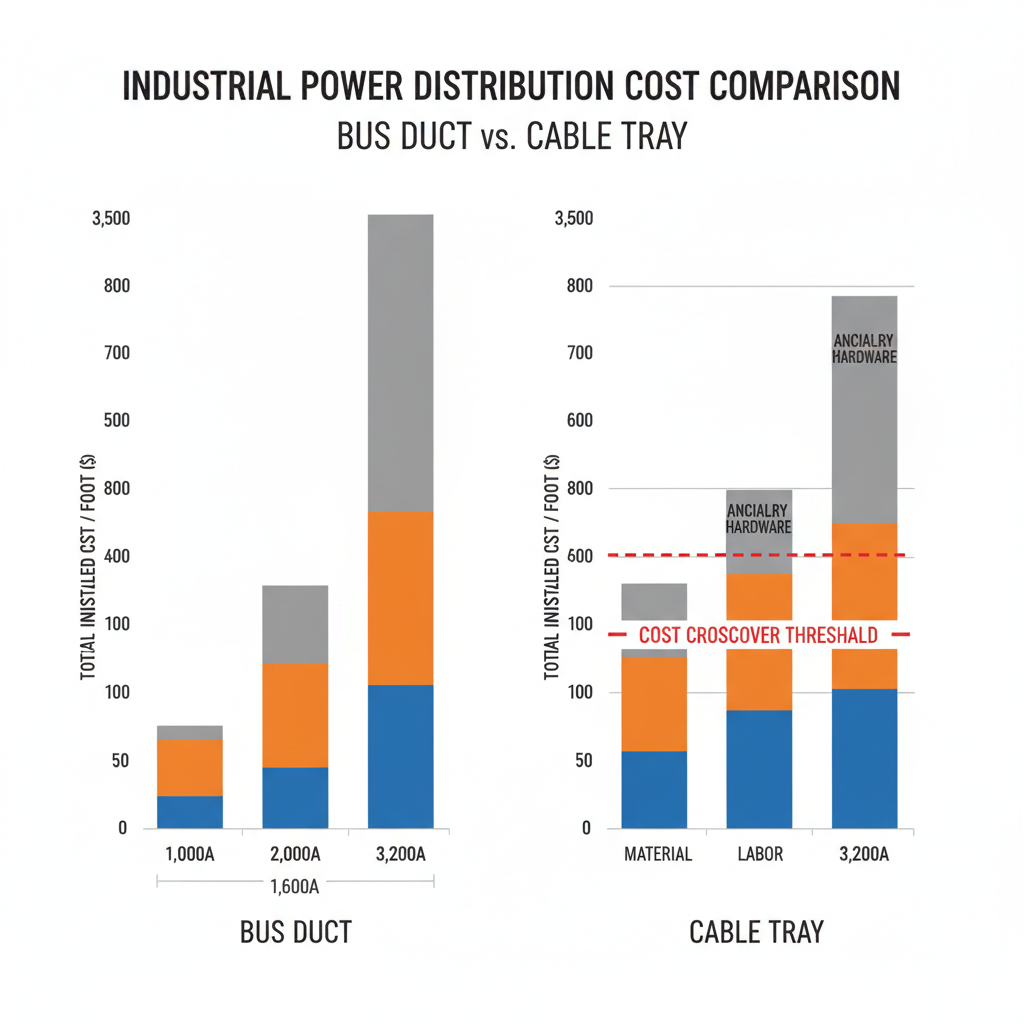
In a typical industrial retrofit at 2,000A, bus duct runs between $180–$320 per foot fully installed, while an equivalent cable-in-tray configuration lands at $95–$210 per foot — but that gap narrows or reverses once you factor in tray modification labor, cable pulling complexity in occupied corridors, and the conductor derating penalties that come with bundled cables in existing trays.

The ranges above are wide for a reason. Retrofit conditions vary dramatically: ceiling height, corridor congestion, proximity to live circuits, and whether the existing tray structure can bear additional load all shift the final number. What the ranges capture is the realistic spread across project types we've documented, not a best-case scenario built to make bus duct look favorable.

How Do Material Costs Break Down Per Foot?

Bus duct material cost per foot — enclosure, copper or aluminum busbars, and factory-assembled insulation — typically runs $110–$220/ft at 2,000A ratings, compared to $55–$130/ft for equivalent-rated cable sets in tray, before any installation variable is applied.

The conductor material choice matters significantly here. Copper busbar costs roughly 30–40% more per foot than aluminum at equivalent ampacity, but copper allows a more compact cross-section, which reduces enclosure size and can simplify routing in constrained spaces. For most industrial retrofit applications at 2,000A and above, aluminum busbar is the economical default unless conductor profile is a hard constraint.

On the cable side, per-foot cost does not scale linearly with ampacity. Above 1,600A, achieving the required current-carrying capacity means running multiple parallel conductors per phase — a 2,000A cable run typically requires three to four conductors per phase, which multiplies material cost, termination hardware, and the number of lugs that need torquing at both ends. Factory pre-assembly in bus duct eliminates field-cut insulation, splice kits, and conductor-separation hardware. Those line items are individually small but collectively add $8–$18/ft in hidden material cost to cable tray systems that procurement quotes routinely omit.

Our production cost data across aluminum and copper busbar configurations at ZHERUTONG informs these material ranges. They reflect actual bill-of-materials cost at the manufacturing stage, not distributor markup assumptions.

Why Does Labor Cost Per Foot Shift So Dramatically in Retrofit Work?

In retrofit projects, cable tray labor cost per foot is routinely underestimated by 35–60% because engineers price the cable pull without accounting for tray modification, existing bundle derating recalculation, and the hours lost to working around live adjacent circuits.

New cable in an existing tray appears straightforward on paper — labor quotes of $15–$35/ft are common in initial estimates. But retrofit-specific multipliers apply in almost every live facility scenario. Confined corridor access, partial shutdowns to de-energize adjacent circuits during pull, and the need to reroute around existing infrastructure all add hours that don't show up in a standard per-foot labor rate.

Bus duct retrofit labor carries a higher base rate — $40–$70/ft including rigging and section alignment — but the run is a single pass with no bundling complexity and no derating recalculation required. Rigging and lifting equipment for bus duct sections is a real cost that must be included in any honest comparison; heavier sections at 3,200A may require a small crane or motorized lift for ceiling-mounted runs, adding $3,000–$8,000 to a 200-foot project depending on facility access.

Based on project documentation from our engineering team at ZHERUTONG, bus duct averages 18–24 crew-hours per 100 feet installed in occupied industrial facilities, compared to 28–45 crew-hours for equivalent cable tray work in the same environment. The cable figure is higher primarily because of the parallel-conductor handling time, tray modification work, and the mandatory re-inspection of existing bundle fill calculations that NEC compliance requires when new conductors are added to an occupied tray.

---

When Does the Per-Foot Cost Equation Favor Bus Duct Over Cable Tray in Retrofit Projects?

Based on retrofit project data, bus duct becomes the lower total-installed-cost option when the run exceeds 150 feet at ampacity ratings above 1,600A, or when existing cable tray fill is already above 40% — whichever threshold is hit first.

This is the question that matters most for a project manager trying to justify a system change to a capital budget committee. A vague "it depends" answer isn't useful. The thresholds above are derived from retrofit project documentation, not theoretical modeling, and they hold across a range of facility types with reasonable consistency.

Is There a Specific Ampacity Threshold Where Bus Duct Wins?

The crossover point is not fixed — it shifts with conductor material prices — but at current copper pricing, bus duct consistently delivers lower per-foot total cost above 1,600A for runs longer than 120 feet in retrofit applications.

The ampacity bands break down as follows:

Ampacity Range

Recommended System

Key Decision Factor

Below 800A

Cable tray

Bus duct factory cost premium not recovered

800A – 1,600A

Contested — evaluate case by case

Tray fill status, load growth forecast, corridor access

Above 1,600A

Bus duct

Parallel cable sets multiply cost exponentially

Below 800A, cable tray almost always wins on per-foot total cost in a retrofit. Bus duct's factory overhead — precision-machined busbar, enclosure fabrication, quality testing — isn't recovered across short, low-ampacity runs where a single conductor per phase handles the load without derating concerns.

The 800A–1,600A range is genuinely contested. The right answer depends on tray fill status, whether load growth is anticipated within five years, and how complex the corridor access is. If a facility is planning capacity expansion, bus duct's tap-off flexibility can shift the economics significantly — avoiding a second retrofit cycle within a few years changes the total cost picture entirely.

Above 1,600A, the parallel cable set multiplication makes the cable option increasingly uncompetitive. At 3,200A, a cable tray solution may require six or more parallel 500kcmil conductors per phase. The material cost alone approaches or exceeds bus duct material cost, before a single labor hour is counted.

What Retrofit-Specific Conditions Tip the Balance?

Three site conditions consistently push the cost crossover toward bus duct earlier than the ampacity threshold alone would suggest: overhead crane clearance restrictions, tray fill already above 40%, and facilities requiring phased energization during live retrofit work.

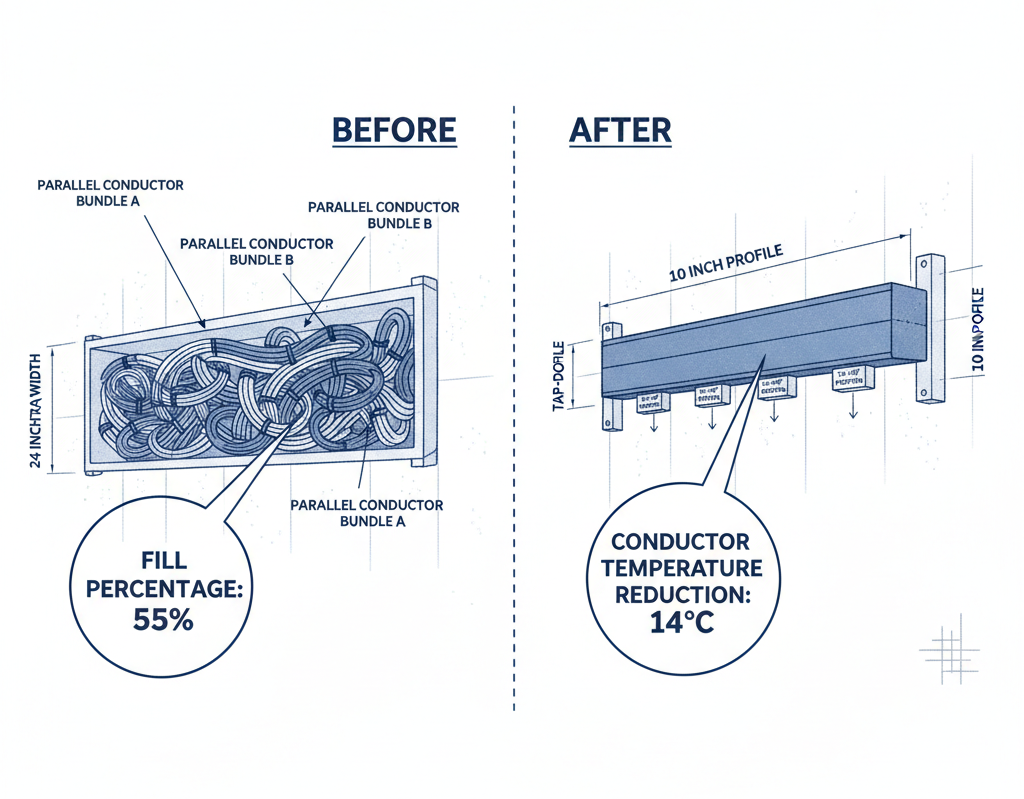
A 2,000A cable tray configuration requires approximately 24 inches of tray width. A 2,000A bus duct runs in a 10-inch profile. In crane bays, that 14-inch difference has structural cost implications — wider tray may require additional hanger reinforcement or route deviation to maintain required crane clearance, costs that appear in structural budgets and are frequently invisible in early electrical estimates.

Tray fill above 40% is the variable our engineering team identifies as the single most underweighted factor in early-stage cost comparisons. Adding conductors to a tray already at 40%+ fill triggers NEC 310.15 derating requirements, which forces larger conductor sizing across the entire new run. That upsizing cascades — larger conductors require larger termination hardware, potentially larger tray sections, and recalculated support spacing. None of these costs appear in the original per-foot cable quote.

Phased energization is the third condition. Bus duct's modular section design allows partial runs to be installed and energized independently. Pulling new cable through an occupied facility typically requires a complete circuit shutdown for the affected zone. In facilities where production downtime carries a measurable daily cost, the scheduling flexibility of bus duct installation can represent more value than any per-foot material comparison captures.

Cable tray retains a genuine advantage in certain scenarios: highly irregular routing paths with more than three directional changes over the run length (bus duct fittings add significant cost at each bend), ampacity requirements below 800A, environments with corrosive vapors that exceed standard IP-rated enclosure options, and projects where upfront capital cost is the overriding constraint regardless of lifecycle economics.

---

How Does a Real Retrofit Project Play Out? A Case Study from Southeast Asia's Automotive Sector

An automotive component manufacturing facility in Southeast Asia faced exactly the cost crossover dilemma described above — and the project outcome confirmed that switching from cable tray expansion to bus duct replacement cut total installed cost by 22% while reducing planned downtime from 14 days to 6 days.

The client was a Malaysian automotive component manufacturer in mid-expansion phase, adding two new press lines requiring an additional 3,200A distribution run across a 280-foot corridor already congested with existing cable trays at 55% fill. The existing infrastructure had been installed in phases over several years, and the tray was carrying a mix of power and control cables that complicated any modification work.

The initial engineering estimate called for six parallel 500kcmil conductors per phase in new tray sections alongside the existing infrastructure. The material and labor quote came in at approximately $268/ft installed, with 14 days of partial production shutdown required for the pull — the corridor access constraints and the live adjacent circuits made faster execution impractical.

ZHERUTONG's engineering team was engaged during the quotation phase and modeled the bus duct alternative. A 3,200A aluminum busway system came in at $241/ft fully installed, including rigging and section alignment — a $27/ft saving on a 280-foot run that translated to approximately $75,600 in direct cost reduction on materials and labor alone.

The solution was a custom 3,200A aluminum bus duct system with IP54 enclosure rating, appropriate for the facility's coolant mist environment. The system was prefabricated in 10-foot sections with pre-drilled tap-off positions at specified intervals, allowing the client to add sub-distribution points for future press line additions without opening the main busway run.

Installation was completed in six working days, with only one 18-hour full shutdown required for the transformer tap connection. Thermal imaging at 90-day post-commissioning showed conductor operating temperatures 14°C lower than the facility's existing cable tray runs at comparable load — a direct result of the bus duct's superior heat dissipation geometry compared to bundled parallel conductors in a partially filled tray.

The question of when to replace cable tray with bus duct in retrofit projects rarely has a clean theoretical answer. This project is representative of what the data actually shows: the tray fill condition was the deciding variable, not the ampacity alone.

---

What Are the Hidden Costs That Per-Foot Quotes Routinely Miss?

The three cost categories most consistently omitted from per-foot quotes are conductor derating penalties under NEC 310.15 for bundled cables, the structural reinforcement required when cable tray loads approach support capacity, and the long-term torque inspection labor that bus duct section joints require — all of which can shift the 10-year cost picture by 15–30%.

Understanding these omissions matters as much as the upfront comparison, particularly for procurement specialists evaluating total cost of ownership rather than capital budget line items.

Why Do Cable Tray Costs Escalate After the Initial Quote?

Derating is the most common source of cable cost escalation in retrofit projects — when tray fill exceeds the threshold for free-air rating, conductor sizing must increase, and that upsizing compounds across every parallel run in the bundle.

NEC 310.15 requires ampacity derating when more than three current-carrying conductors share a raceway or are bundled together. In a retrofit tray already carrying six to eight conductors, adding more triggers a cascade: the new conductors must be sized larger to compensate for the derating factor, which increases material cost, may require larger lugs and termination hardware, and can push the tray fill percentage higher — potentially triggering additional derating on the existing conductors already in the tray.

Tray structural loading is a second hidden cost. Adding cable weight to an existing tray may require hanger reinforcement or additional support points. This cost appears in the structural budget, not the electrical estimate, and is frequently invisible during the electrical cost comparison phase. On a 300-foot run with cable added at 40+ lbs per foot, the structural reinforcement cost can reach $15,000–$25,000 before the first conductor is pulled.

Termination labor compounds across the life of the system. Multiple parallel conductors mean multiple termination points at both ends of the run — each one a torque-check point that must be inspected on a recurring schedule. A 3,200A cable run with six parallel conductors per phase has 36 termination points per end, or 72 total. A bus duct run of equivalent rating has four termination connections at each end.

What Long-Term Maintenance Costs Should Bus Duct Buyers Budget For?

Bus duct is not maintenance-free — section joints require periodic torque inspection, typically every 3–5 years, and in high-humidity industrial environments, condensation management adds a recurring cost that cable tray systems don't carry.

Section joint torque inspection on a 300-foot bus duct run with 10-foot sections means 30 joint locations. At current industrial electrician rates, a full torque inspection of a 300-foot run takes approximately 8–12 hours, budgeted every three to five years under normal thermal cycling conditions. In facilities with significant load variation or high ambient humidity, annual inspection is the more conservative recommendation.

Condensation is a genuine risk in environments with significant temperature cycling — cold starts in unheated facilities, or processes that generate significant heat followed by idle periods. Space heaters are available as accessories for bus duct enclosures in these environments, adding both upfront cost ($200–$600 per heater, spaced approximately every 30 feet in high-risk zones) and a recurring maintenance item.

The maintenance advantage bus duct holds over cable tray is thermal imaging access. Infrared scanning of a bus duct run can be performed without removing covers or exposing conductors, reducing both the time required and the arc flash exposure risk to maintenance personnel. On a cable tray system, identifying a developing hot spot at a termination requires physical access to individual conductors. Over a 10-year operating period, the labor cost differential for thermal inspection alone can reach $8,000–$15,000 on a 300-foot run, depending on facility inspection frequency and labor rates.

---

When Should a Retrofit Project Manager Replace Cable Tray With Bus Duct — and When Should They Not?

Replace cable tray with bus duct when you're above 1,600A, running more than 120 feet, and facing either tray fill constraints or crane clearance restrictions — keep cable tray when your routing is highly irregular, your ampacity is below 800A, or your environment involves corrosive vapors that eliminate standard bus duct enclosure options.

Replace with bus duct when:

  • Ampacity requirement exceeds 1,600A and run length exceeds 120 feet
  • Existing tray fill is at or above 40%, triggering a derating cascade that makes cable conductor sizing uneconomical
  • Overhead crane clearance makes wide tray configurations a safety or operational liability
  • Load growth is anticipated — bus duct tap-off flexibility avoids a second retrofit cycle within five years
  • Phased installation is required to keep production running during the upgrade

Keep cable tray (or cable bus) when:

  • Routing involves more than three directional changes over the run length — bus duct fittings add meaningful cost at each bend, and complex routing paths erode the labor efficiency advantage
  • Ampacity is below 800A — the factory cost premium embedded in bus duct manufacturing isn't recovered at low current ratings over typical run lengths
  • Corrosive or chemically aggressive environments exceed standard IP54/IP65 enclosure ratings and require non-metallic or specialized enclosure materials
  • Budget is constrained to lowest upfront capital cost and lifecycle analysis is not part of the decision framework

One of the consistent findings from our engineering team's retrofit assessments at ZHERUTONG is that tray fill percentage is the single most underweighted variable in early-stage cost comparisons. Engineers who price the cable option before pulling the tray fill calculation are routinely surprised when the derating-adjusted conductor sizing closes the gap with bus duct material cost before a single labor hour is counted.

---

Frequently Asked Questions

Q1: Is bus duct always more expensive per foot than cable tray upfront?

Not at higher ampacity ratings. Above 1,600A with runs over 120 feet, bus duct's material and labor efficiency typically produces lower total installed cost than parallel cable sets in tray. The upfront cost assumption is most likely to hold below 800A, where cable tray's simplicity and lower factory cost overhead make it genuinely the more economical choice.

Q2: How often do bus duct section joints need to be re-torqued in an industrial environment?

Every three to five years under normal thermal cycling conditions. Annual inspection is recommended in facilities with significant load variation, high ambient humidity, or processes that generate substantial heat followed by extended idle periods. Torque inspection is faster than equivalent cable termination inspection because joint locations are fixed and accessible without conductor exposure.

Q3: Can bus duct be installed in phases to minimize production downtime during a retrofit?

Yes — modular section design allows partial runs to be installed and energized independently, which is one of the key scheduling advantages in live-facility retrofits. The Malaysian automotive case documented above achieved full installation in six working days with a single 18-hour shutdown, compared to a 14-day partial shutdown estimated for the cable alternative.

Q4: What IP rating should I specify for bus duct in a manufacturing environment with coolant mist?

IP54 is the standard minimum for environments with non-directional liquid splash or dust ingress risk. IP65 is appropriate for wash-down zones or areas with heavy particulate exposure. Specifying below IP54 in a coolant mist environment introduces condensation and contamination risk at section joints that will accelerate maintenance intervals and increase long-term operating cost.

Q5: At what run length does the cost crossover between cable tray and bus duct typically occur for a 2,000A retrofit?

Based on current conductor material pricing and typical retrofit labor rates, the crossover generally occurs between 100–150 feet for a 2,000A run. That threshold shortens to 80–100 feet when existing tray fill derating applies, because the conductor upsizing required for NEC compliance closes the material cost gap before the run length advantage of bus duct's single-pass labor efficiency has fully accumulated.

---

If you're working through a facility upgrade and need a per-foot cost model built against your specific ampacity, run length, tray fill status, and site conditions, our engineering team at ZHERUTONG can run the comparison using your actual project parameters — not generic benchmarks. Send your project requirements, load schedules, or corridor drawings directly to rtdq@rtbusway.com and we'll return a structured cost comparison within your project timeline.

문의하기

궁금한 점이 있으시면 언제든지 문의해 주세요! 주저하지 마시고 연락 주세요. 저희는 고객 만족을 위해 최선을 다하고 있습니다.
이름*
Company Name*
이메일*
Country
메시지*
메시지를 남겨주세요
이름*
Company Name*
이메일*
Country
메시지*