카테고리

What Is The Best Bus Duct Vs Cable Tray Cost Comparison For Industrial Plants?

Raw material price is just the start. Get a full bus duct vs cable tray cost comparison for industrial plants covering installation, labor, and lifecycle TCO.
May 28th,2026 5 견해

The best bus duct vs cable tray cost comparison for industrial plants evaluates not just the upfront material price, but the entire lifecycle encompassing installation labor, support structures, and long-term maintenance.

At ZHERUTONG, we constantly interact with electrical engineers, procurement managers, and OEM clients who are in the critical stages of designing heavy industrial infrastructure. A recurring issue we observe is the tendency to evaluate power distribution options purely based on the raw cost of copper or aluminum per meter. This overly simplistic approach often leads to disastrous budget overruns during the construction phase and inflated operational expenses over the facility's lifespan. To truly understand the financial implications of your design choices, you must conduct a comprehensive bus duct vs cable tray cost comparison for industrial plants that accounts for the Total Cost of Ownership.

Our manufacturing expertise has shown us that modern industrial environments require power distribution networks that are not only robust but also adaptable to rapid technological shifts. The traditional method of running multiple heavy cables through extensive tray networks is increasingly clashing with the spatial and financial realities of contemporary facility design. By examining the hidden costs associated with installation manpower, structural reinforcement, thermal inefficiencies, and future expansion limitations, procurement teams can make highly informed, data-driven decisions that protect their capital investments.

Why Compare Bus Duct And Cable Tray?

Comparing bus duct and cable tray costs reveals that while cables appear cheaper initially, the extensive labor and structural reinforcements required in industrial plants quickly reverse this cost advantage.

Engineers often default to the familiar bus duct vs cable debate without running a localized spatial and labor overhead calculation. In our experience at the ZHERUTONG manufacturing facilities, we have audited hundreds of facility blueprints where standard cable trays caused severe budget overruns due to unforeseen structural complexities. The current global shortage of skilled electrical labor means that any system requiring prolonged, manual installation processes will inherently carry a massive financial risk. A realistic bus duct vs cable tray cost comparison for industrial plants must mathematically factor in these unpredictable labor variables alongside the static material costs.

What Are The Hidden Installation Labor Expenses?

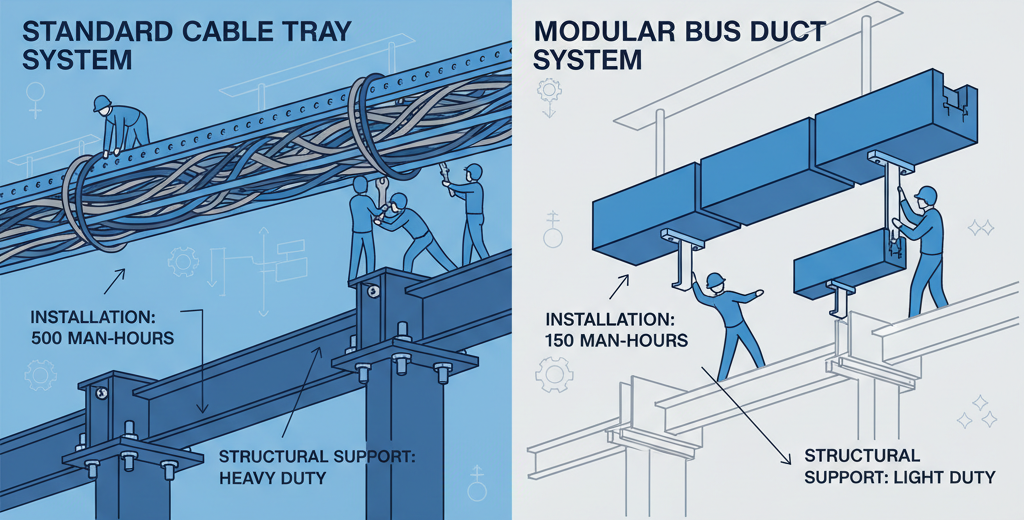
Hidden installation expenses for cable trays include hundreds of skilled man-hours spent pulling, terminating, and securing multiple heavy conductors, whereas modular bus ducts simply bolt together.

The physical process of installing traditional wiring is incredibly labor-intensive. Pulling thick cables through overhead trays requires heavy mechanical winches, extensive scaffolding, and a large crew to guide the conductors and prevent insulation damage. Once pulled, each individual cable must be painstakingly stripped, fitted with heavy-duty lugs, crimped, and terminated at both the switchgear and the machinery ends. This process is not only slow but highly susceptible to human error, which can lead to catastrophic electrical faults.

Contrast this outdated method with ZHERUTONG's modular busway systems. Our power distribution solutions arrive at your facility prefabricated to your exact dimensional specifications. The installation process is transformed from a chaotic pulling operation into a streamlined mechanical assembly. A significantly smaller crew simply lifts the rigid sections into place, aligns the joints, and tightens a specialized double-headed breakaway bolt to achieve the perfect torque. This plug-and-play methodology reduces the installation schedule from months to mere weeks, drastically slashing the labor budget and allowing the facility to commence production much earlier than anticipated.

How Does Support Spacing Impact Material Budgets?

Support spacing impacts material budgets because heavy cable trays require structural brackets every few feet to prevent sagging, while rigid bus ducts span significantly longer distances.

When evaluating secondary material costs, the mechanical rigidity of the chosen power distribution system plays a pivotal role. Flexible cables possess no structural integrity of their own, meaning the entire weight of the copper or aluminum must be borne by the tray system. To prevent dangerous sagging and ensure compliance with building codes, heavy cable trays must be supported by ceiling hangers and structural steel brackets at very short intervals, often every one to two meters.

Because ZHERUTONG bus ducts are encased in robust metal housings, they possess inherent mechanical strength. This allows our systems to span significantly longer distances between support points, often up to three meters or more depending on the specific amperage rating. Reducing the number of required hangers directly lowers the volume of secondary steel materials you need to purchase. Furthermore, it minimizes the time spent drilling into concrete ceilings and welding support structures, further compounding the financial savings during the construction phase.

When Is Bus Duct Better Than Cable?

Bus duct is definitively better than cable when industrial plants require distributing power above 1000 amps over long distances with minimal voltage drop and strict space constraints.

Knowing precisely when to choose bus duct over cable in high amperage applications is the most critical decision an electrical engineer will make during the design phase. Standard bus duct vs cable debates often ignore the physical impossibility of routing dozens of thick cables in modern, space-optimized manufacturing corridors. As industrial machinery becomes more powerful and complex, facility layouts are increasingly congested. Attempting to force a massive, multi-tiered cable tray network through these tight spaces often results in clashes with HVAC ductwork, plumbing, and overhead lifting equipment, forcing costly redesigns.

How Do High Amperages Change Cost Dynamics?

High amperages change cost dynamics because traditional wiring requires multiple parallel runs to handle massive loads, multiplying material costs, whereas a single bus duct handles high currents efficiently.

The concept of cable derating is a major financial pitfall for inexperienced procurement managers. When multiple cables are bundled together in a tray, they generate excess heat. Because this heat cannot dissipate efficiently, electrical codes force engineers to oversize the cables to prevent insulation failure and fire hazards. For example, a requirement for 2500 amps might theoretically be met by a certain gauge of wire, but due to derating, you are forced to run six or seven parallel sets of thick cables. This instantly multiplies the amount of copper required, destroying any initial material cost advantage.

A compact bus duct eliminates these derating issues entirely. ZHERUTONG engineers design our high-amperage systems utilizing advanced air or epoxy insulation techniques that provide superior thermal dissipation. A single, sleek bus duct run can easily handle loads that would otherwise require an enormous, heat-generating bundle of cables. By maintaining optimal operating temperatures without the need for parallel runs, the material efficiency of our busway systems remains unmatched in heavy industrial scenarios.

Why Is Voltage Drop Crucial For Engineers?

Voltage drop is crucial for engineers because excessive power loss in long cable runs increases operational energy costs and forces the costly upsizing of copper conductors.

In any extensive industrial facility, the distance between the main transformer and the end-use machinery can be substantial. As electrical current travels through traditional cables, the natural impedance of the wire causes a drop in voltage. If this voltage drop exceeds acceptable thresholds, sensitive industrial machinery will draw more current to compensate, leading to overheating, premature motor wear, and significantly higher monthly electricity bills. To combat this, engineers are often forced to specify even thicker, more expensive cables simply to overcome the distance.

ZHERUTONG busbars are engineered with a highly optimized, low-impedance design. The geometric arrangement of the flat conductors within our housing significantly reduces both the skin effect and the proximity effect that plague round cables. This ensures that power is transmitted across your facility with maximum efficiency and minimal voltage drop. By preserving the integrity of the power supply, our systems protect your sensitive OEM equipment and deliver measurable energy savings throughout the operational life of the plant.

Which System Yields Better Total Ownership Costs?

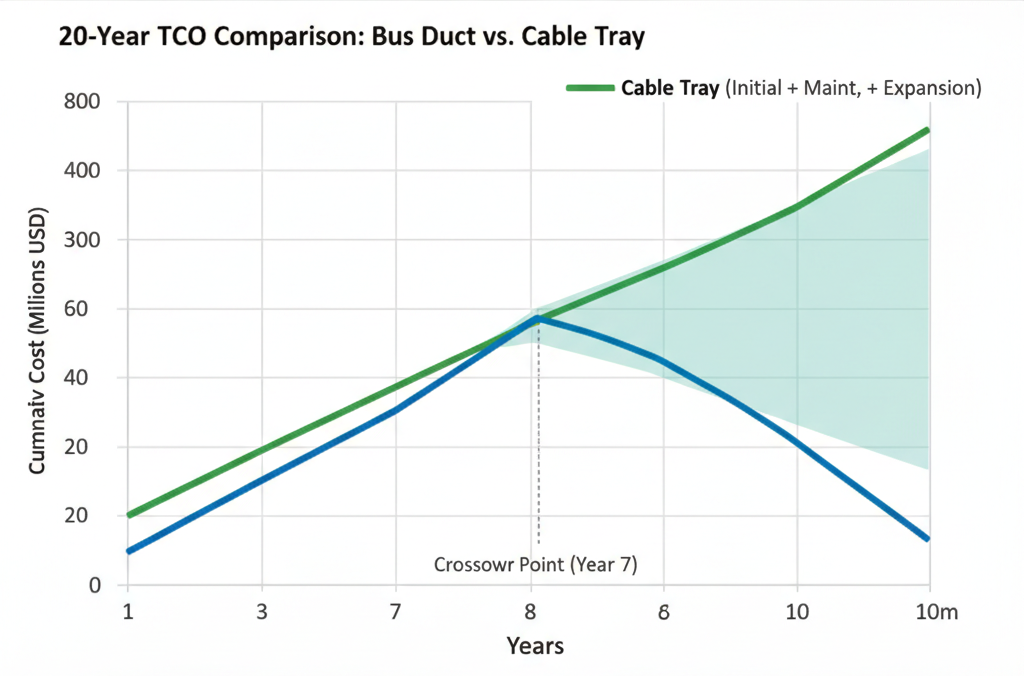
A bus duct system yields a better total cost of ownership by drastically reducing ongoing maintenance hours, minimizing energy losses, and simplifying future plant expansions.

The true financial impact of an electrical distribution network is realized over its twenty to thirty-year lifecycle. While initial procurement budgets are important, a comprehensive bus duct vs cable tray cost comparison for industrial plants proves its worth during the operational phase. Facilities that prioritize low upfront material costs often find themselves trapped in a cycle of expensive maintenance, inefficient energy consumption, and highly disruptive upgrade procedures. Shifting the focus from Capital Expenditure to Operational Expenditure reveals the undeniable superiority of modular busway architecture.

What Are The Long Term Maintenance Differences?

The primary maintenance difference is that bundled cables deteriorate thermally and are difficult to inspect, whereas bus duct joints allow for rapid thermal imaging and simple retorquing.

Maintaining a multi-run cable tray system is a logistical nightmare for facility management. Over time, dust and debris accumulate within the open trays, creating an insulating blanket that traps heat and accelerates the thermal degradation of the cable insulation. Tracing a specific fault within a tangled bundle of identical wires requires extensive downtime, specialized testing equipment, and significant labor. Furthermore, replacing a damaged cable often means pulling an entirely new line across the facility.

ZHERUTONG bus duct systems are engineered for total transparency and ease of maintenance. Our enclosed designs prevent the accumulation of hazardous dust, protecting the internal conductors. During routine plant shutdowns, maintenance personnel can easily conduct visual inspections and utilize thermal imaging cameras directly at the joint connections to identify any potential hotspots before they cause a failure. If an issue is detected, resolving it is usually as simple as retorquing a specific joint bolt, requiring minimal time and virtually zero replacement materials.

How Do Expansion Needs Affect Future Budgets?

Expansion needs affect future budgets because adding a new machine to a cable tray requires pulling new wire from the main panel, while bus ducts allow for simple plug-in tap-off boxes.

Industrial plants are dynamic environments; production lines are frequently reconfigured, and new machinery is constantly being integrated. If your facility relies on a traditional cable tray network, adding a single new heavy-duty machine requires a massive undertaking. Electricians must measure, cut, and pull a brand new set of cables all the way from the main distribution panel to the new equipment location. This process disrupts ongoing operations, requires new structural supports, and consumes a significant portion of the annual maintenance budget.

Busway systems inherently solve this problem through their modular design. ZHERUTONG bus ducts feature designated plug-in openings along their entire length. When a new machine is installed, electricians simply insert a customized tap-off box into the nearest available opening, instantly safely accessing the power supply without touching the main switchgear. This plug-and-play capability allows engineers to safely add power drops without extensive rewiring or prolonged facility downtime, making it a critical factor for OEM clients who demand maximum operational agility.

How Did One Plant Save Significant Capital?

A heavy manufacturing plant in Southeast Asia saved over thirty percent in total electrical infrastructure costs by replacing their planned multi-run cable tray design with a customized ZHERUTONG bus duct solution.

To illustrate the tangible benefits of our engineering approach, we frequently share data from real-world interventions. Recently, a newly constructed automotive parts manufacturing facility in Southeast Asia engaged our team for a comprehensive infrastructure review. The client had initially approved a traditional wiring scheme, but as construction commenced, they realized the projected costs were spiraling out of control. By applying our rigorous analytical framework, we were able to identify massive inefficiencies in their design and propose a solution that protected their bottom line.

What Was The Southeast Asian Facility Facing?

The facility was facing severe spatial constraints in their overhead crane corridors and exorbitant labor estimates for pulling thousands of meters of thick copper cables.

The initial blueprint for the automotive plant specified a massive cable tray network to support a critical 3200-amp main distribution line. Because of the extreme amperage and the local regulatory derating requirements, the design called for eight parallel runs of heavy copper cables. The physical footprint of this tray system was enormous, creating a direct physical conflict with the required clearance for the heavy overhead gantry cranes necessary for moving stamping dies.

Beyond the spatial impossibility, the financial projections were alarming. The local labor contractors submitted exorbitant estimates for the prolonged installation schedule required to pull, secure, and terminate such a massive volume of thick copper wire. The sheer time required for this manual labor directly threatened the project's launch date, putting the client at risk of missing critical delivery milestones for their automotive partners.

How Did ZHERUTONG Deliver Quantifiable Cost Reductions?

ZHERUTONG delivered quantifiable cost reductions by engineering a compact, high-amperage bus duct layout that eliminated parallel cable runs and cut installation time by weeks.

Our site assessment team immediately recognized that understanding when to choose bus duct over cable in high amperage applications was the key to rescuing this project. We engineered a customized, high-efficiency sandwich-type bus duct system specifically tailored to their 3200-amp requirement. This single, highly compact run completely eliminated the need for the eight parallel cable sets. The physical footprint of the power distribution was reduced dramatically, effortlessly clearing the pathway for the overhead cranes and eliminating the need for architectural modifications.

The financial results were undeniable. Because our modular system arrived prefabricated, the installation time was slashed from an estimated two months to just under three weeks. The reduction in skilled man-hours, combined with the elimination of heavy steel support brackets and the superior thermal performance of our conductors, resulted in massive capital savings. The final bus duct vs cable tray cost comparison for industrial plants showed a clear thirty percent reduction in total infrastructure expenditure for the client, proving the immense value of partnering with a specialized manufacturer.

What Are Common Power Distribution System Questions?

Common power distribution system questions revolve around the longevity, environmental adaptability, and ecological impact of modern modular electrical infrastructure.

While the financial and operational benefits of modular power distribution are clear, engineers and procurement managers often have specific technical inquiries before committing to a system overhaul. At ZHERUTONG, we believe in complete transparency regarding the capabilities and limitations of our manufactured solutions. Addressing these fundamental concerns is a crucial step in helping our clients transition away from outdated wiring methodologies and embrace the efficiency of modern infrastructure.

How Long Does A Bus Duct Last?

A well-maintained bus duct system typically lasts between thirty to fifty years, significantly outperforming the standard lifecycle of traditional industrial cables.

The longevity of a power distribution system is a direct reflection of its material quality and thermal management capabilities. Traditional industrial cables rely on polymer or PVC insulation, which naturally degrades over time due to continuous heat exposure, environmental factors, and physical stress. This degradation often forces facilities to undertake massive rewiring projects every twenty to thirty years to prevent catastrophic insulation failures.

ZHERUTONG systems are constructed using premium-grade aluminum or copper conductors housed within highly durable metal enclosures. Because our designs utilize superior insulation materials like epoxy or specialized air gaps, the thermal stress on the system is minimized. When combined with our rigorous manufacturing standards and the ease of routine maintenance, our installations routinely operate safely and efficiently for up to half a century, providing an unmatched return on investment for heavy industrial applications.

Can Bus Ducts Be Installed Safely Outdoors?

Bus ducts can be installed safely outdoors if they are specifically engineered with high IP ratings and weather-resistant enclosures to protect the internal busbars from moisture and dust.

A common misconception is that modular power distribution is strictly limited to indoor, climate-controlled environments. While standard indoor systems are not suitable for exterior use, specialized manufacturing techniques have completely solved this limitation. Industrial plants frequently require power to be routed between separate buildings, across rooftops, or through areas exposed to harsh weather conditions.

For these demanding applications, ZHERUTONG engineers cast-resin or highly sealed outdoor busway systems. These specialized units feature advanced ingress protection ratings that render them completely impervious to heavy rain, snow, corrosive industrial atmospheres, and extreme temperature fluctuations. The seamless integration of these outdoor rated sections with our standard indoor runs allows facility engineers to design a continuous, highly efficient power network that spans the entire footprint of their industrial complex without reverting to vulnerable outdoor cable trenches.

Are Bus Ducts Considered Environmentally Friendly Systems?

Bus ducts are considered environmentally friendly systems because they are composed of up to ninety-five percent recyclable metals and eliminate the toxic polymer waste associated with discarded cable insulation.

Sustainability is no longer a secondary consideration for modern industrial original equipment manufacturers; it is a core metric of facility design. Traditional cable systems present a massive environmental challenge at the end of their lifecycle. The thousands of meters of thick PVC or cross-linked polyethylene insulation are notoriously difficult to recycle and often end up in landfills, creating long-term toxic waste issues. Furthermore, the inherent energy losses due to voltage drop in long cable runs contribute to a higher overall carbon footprint for the facility.

ZHERUTONG is committed to sustainable manufacturing practices. Our power distribution solutions are primarily constructed from highly recyclable aluminum, copper, and steel. When a facility is eventually decommissioned or heavily modified, the modular sections can be easily dismantled, repurposed, or fully recycled with minimal environmental impact. Additionally, the low-impedance design of our conductors ensures maximum energy transmission efficiency, directly reducing the operational power consumption and carbon emissions of the industrial plants we serve.

How Should You Start Your Project Design?

You should start your project design by evaluating your specific amperage requirements, spatial limitations, and long-term expansion goals alongside a specialized manufacturer like ZHERUTONG.

Relying on outdated assumptions about wiring costs can financially cripple a modern industrial facility before the first machine is even turned on. As we have demonstrated, understanding when to choose bus duct over cable in high amperage applications is the key to unlocking long-term operational efficiency and preserving your capital budget. A customized bus duct vs cable tray cost comparison for industrial plants is unique to every facility's layout, load demands, and future growth projections.

Do not leave your critical power distribution architecture to guesswork or generic estimates. We invite procurement teams, facility engineers, and OEM project managers to leverage our extensive manufacturing expertise. Send your specific project needs, electrical drawings, requests for samples, or custom manufacturing requirements directly to our engineering team at: rtdq@rtbusway.com. ZHERUTONG is ready to engineer a solution that maximizes your spatial efficiency, slashes your installation time, and secures your facility's power reliability for decades to come.

문의하기

궁금한 점이 있으시면 언제든지 문의해 주세요! 주저하지 마시고 연락 주세요. 저희는 고객 만족을 위해 최선을 다하고 있습니다.
이름*
Company Name*
이메일*
Country
메시지*
메시지를 남겨주세요
이름*
Company Name*
이메일*
Country
메시지*